How to Reset Your Budget and Take Back Control of Your Money
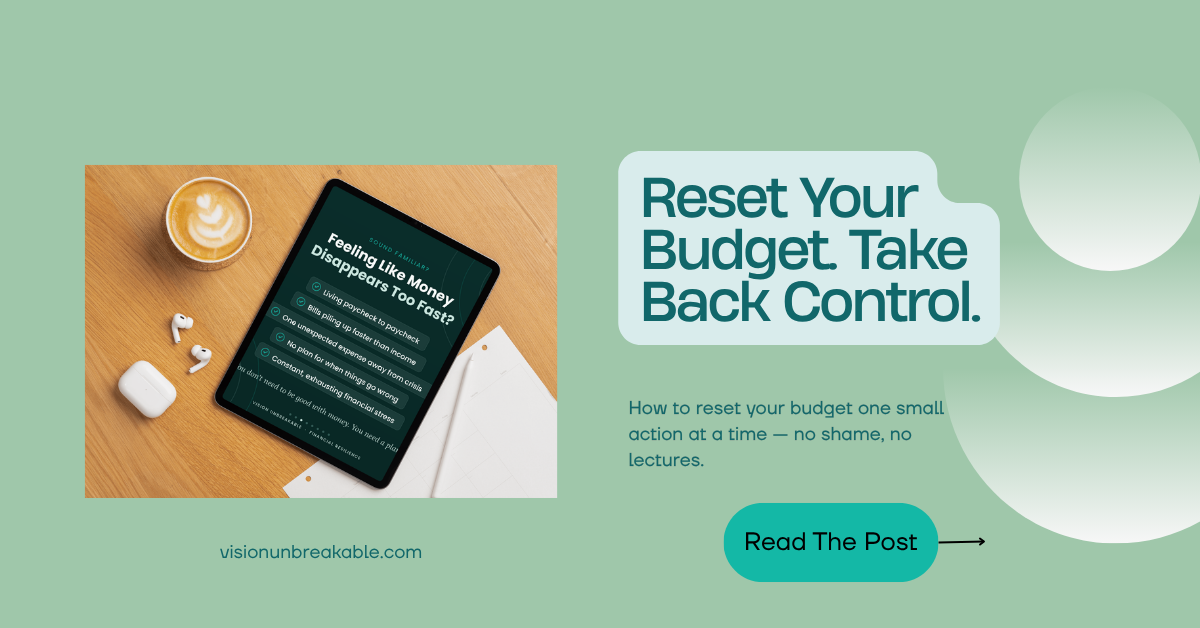
If you've ever built a budget, stuck to it for two weeks, and then watched it fall apart — you're not bad with money. You had a budget built on the wrong foundation. And the answer isn't to try harder with the same broken plan. It's to reset.
A budget reset means wiping your financial slate clean: no guilt about last month, no pretending your numbers are different than they are. Just an honest look at what's really coming in, what really has to be paid, and a step-by-step rebuild from there. Whether you're recovering from a job loss, buried by inflation, hit with an unexpected bill, or simply starting over, this guide walks you through the full reset — including a 30-day plan to make it stick.
Why Budgets Fail (and Why Yours Isn't Hopeless)
Most budgets don't fail because people lack discipline. They fail for three predictable reasons:
- They're built on ideal numbers, not real ones. The budget assumes your best-case income and your most optimistic spending — so the first surprise expense breaks it.
- They ignore irregular income. If your pay varies week to week — gig work, tips, freelance — a budget built on your average month collapses in a low month.
- They run on guilt. One overspend feels like failure, failure feels like proof you "can't budget," and the whole thing gets abandoned. The shame cycle kills more budgets than the math ever does.
A reset breaks all three patterns at once, because it starts from truth instead of hope.
What a Budget Reset Actually Means
A budget reset is not another app or another envelope system. It's a short, honest process: get your real numbers on paper, protect the essentials first, cut what's quietly draining you, organize your debt, and then track for a few weeks so the new plan reflects your actual life. You don't need to be good with money to do it. You need a pen and about 30 minutes to start.
The 6-Step Budget Reset
Step 1: Take a true income snapshot
List every source of money you're certain of receiving this month — wages, a second job, benefits, child support, gig work, side income. Then total it.
One rule that changes everything for variable income: use your lowest recent month as your number, not your average. Plan for the worst, hope for the best. If your budget works in a low month, a good month becomes a bonus instead of a bailout.
Step 2: List your essential bills in priority order
Essentials get protected before anything else, in this order:
- Food and medicine
- Housing (rent or mortgage)
- Utilities
- Car payment and insurance, if you need the car for work
- Minimum debt payments
- Everything else
Write each bill down with its amount and due date, and note honestly whether you're current or behind. This single list — real amounts, real dates — is the backbone of your entire budget.
Step 3: Audit your non-essential spending
Pull up your last 30 days of bank and card statements and write down what you actually spent on streaming, takeout, coffee runs, subscriptions, shopping, and the rest. For each category, make one decision: cut it, reduce it, or keep it.
You don't have to cut everything forever — just until you're stable. Even finding $150 a month here buys you $1,800 of breathing room per year.
Step 4: Stretch your grocery budget
Food is the most flexible essential, which makes it the fastest place to free up cash. Set a monthly grocery number, then break it into a weekly and daily amount so it's easy to stay on track. Lean on cheap, high-nutrition staples — dried beans and lentils, rice, oats, eggs, frozen vegetables, cabbage — and follow a few simple rules: shop from a list, never shop hungry, and choose store brands, which run 20–40% cheaper with comparable quality.
Step 5: Organize your debt with the snowball method
List every debt with its balance, minimum payment, and interest rate. Then use the snowball: pay minimums on everything, and put every extra dollar toward the smallest balance. When that debt disappears, roll its payment into the next smallest. The early wins build momentum — which is exactly what a reset needs.
Two more rules: call your creditors and ask about hardship programs (most have one; they just don't advertise it), and never let silence do the talking. Communication keeps options open; disappearing closes them.
Step 6: Track every dollar for two weeks
For the next 14 days, write down every purchase — no matter how small — and label it a need or a want. No judgment, just awareness. At the end of each week, add it up. Most people are genuinely shocked by what they find, and that awareness alone redirects money back toward bills and savings.
The 30-Day Budget Reset Challenge
Knowledge doesn't rebuild a budget — daily action does. That's why the most effective way to run a reset is as a 30-day budget challenge: one small money action per day. Small enough that you can't fail, consistent enough that it compounds. For example:
- Day 3: cancel or pause one subscription you forgot you had
- Day 7: complete your first no-spend day
- Day 12: comb your bank statement for forgotten recurring charges
- Day 17: open a free savings account just for your emergency fund
- Day 21: transfer money to savings — even $10 starts the habit
- Day 29: set up an automatic weekly transfer so saving happens without willpower
By day 30, you're not the same person who started — you have a working budget, a call log, a savings habit, and proof that you can run your money instead of it running you. And if you'd like the entire challenge laid out for you day by day, our companion ebook, The 30-Day Budget Reset, walks you through the complete plan step by step.
Traditional Budgeting vs. a Budget Reset
| Traditional Budgeting | Budget Reset Method | |
|---|---|---|
| Starting point | Ideal income and estimated spending | Real numbers from your actual statements |
| Variable income | Budgets the average month | Budgets the lowest recent month |
| Bill approach | Everything treated equally | Essentials protected in priority order |
| Debt approach | Scattered payments | Snowball method with creditor scripts |
| When you overspend | Guilt, then abandonment | Adjust and continue — awareness, not shame |
| Timeline | Open-ended | 30 days, one action per day |
The Workbook That Walks You Through Every Step
You can absolutely run this reset with a notebook. But if you'd rather have every worksheet, checklist, and script already built — in the right order, with nothing to figure out — that's exactly what the Budget Reset Planner was created for.
Inside the workbook you'll find:
- A 24-Hour Money Triage checklist for when things feel urgent
- Monthly income snapshot and essential bills priority worksheets
- A non-essential spending cut list and grocery stretch plan
- Debt payoff planning tools using the snowball method
- Word-for-word phone scripts for late bills and payment plan negotiations
- An emergency resource list — free food, utility, and health assistance programs
- A side income brainstorm sheet and weekly spending trackers
- The complete 30-Day Budget Reset Plan with one action per day
It's an instant digital download for $8.99, and it comes as a printable PDF plus editable Google Docs and Microsoft Word versions — so you can print it, type in it, or both.
Get the Budget Reset Planner here →
Frequently Asked Questions
How long does a budget reset take?
The initial reset — income snapshot, bills list, and spending audit — takes about 30 minutes with a pen and your bank app. The full rebuild runs 30 days, with one small action per day.
What if my income changes every month?
Budget from your lowest recent month rather than your average. That way the plan holds in a lean month, and stronger months create surplus you can push toward debt or savings instead of scrambling to cover gaps.
Do I need an app or a spreadsheet to do this?
No. A reset works on paper — in fact, physically writing your numbers often makes them feel more real. The Budget Reset Planner gives you printable and editable versions so you can use whichever fits your life.
What's the difference between the Budget Reset Planner and the 72-Hour Financial First Aid Kit?
The 72-Hour Financial First Aid Kit is for the acute crisis — the first days after a job loss or major unexpected bill, when triage and creditor calls matter most. The Budget Reset Planner is the full rebuild: resetting your spending, organizing your debt, and establishing a budget that lasts. Many people use them together — stabilize first, then reset.
How do I stay consistent after the 30 days?
Keep the two habits that carry the most weight: a weekly spending check-in and an automatic transfer to savings, even a small one. Consistency comes from systems that run without willpower — not from motivation.
Your Clean Slate Starts Today
You don't need a perfect financial history to take back control — you need real numbers, a priority order, and one action a day. Hard times don't last, but the habits you build during them do. If you want the entire reset laid out for you step by step, the Budget Reset Planner is ready when you are.
This article is for informational and educational purposes only and does not constitute financial or legal advice. Prices and program details are subject to change.
-
Posted in
30 day budget challenge, budget reset, budgeting tips, debt payoff, financial planning, money management, monthly budget, personal budget