Financial Emergency? A 72-Hour Money Survival Plan to Regain Control Fast
The layoff email. The transmission that just died. The medical bill that showed up with a number you can't stop staring at. However it arrived, you're in a financial emergency — and your mind is probably racing through worst-case scenarios right now.
Take a breath. Here's the truth that matters most in this moment: what you do in the next 72 hours will shape the next 6 months of your financial life. Not because the problem gets solved in three days — it won't — but because the first 72 hours determine whether you respond with a plan or with panic. And when money gets tight, the people who have a plan survive. The people who panic do not.
This guide walks you through a complete 72-hour money survival plan, hour by hour. No shame, no lectures — just the exact steps to stabilize your situation and regain control fast.
Why the First 72 Hours of a Financial Emergency Matter So Much
When a money crisis hits, most people make their most expensive mistakes in the first few days — not because they're careless, but because panic pushes them into one of two traps:
- Avoidance: not opening the bills, not checking the account balance, hoping it somehow resolves itself. Silence is the most expensive strategy there is — late fees stack, options shrink, and creditors become far less flexible once you've already missed a payment.
- Panic moves: paying the loudest bill instead of the most important one, draining savings on the wrong debt, or reaching for a high-interest loan that turns a bad month into a bad year.
A 72-hour financial recovery plan replaces both with something better: a short, ordered list of actions. You don't need to be good with money to follow it. You need a pen, your bank app, and a willingness to look at the real numbers.
Hours 0–24: Stop the Bleeding
Face your real numbers first
Before you make a single decision, you need an honest snapshot. In the first hour, write down four numbers:
- Your current bank balance — right now, not from memory
- Every bill due in the next 14 days, added together
- The physical cash you have at home or in your wallet
- Any income you're certain is arriving in the next 7 days
These four numbers are your emergency budget. They tell you exactly how much runway you have and how urgent things really are. Scary or not, knowing is always better than not knowing — you can't triage what you refuse to look at.
Freeze all non-essential spending
Next, stop money from leaking out while you plan:
- Pause every non-essential auto-payment immediately
- Cancel or pause subscriptions — streaming, apps, gym memberships
- Put the credit cards out of sight for today to remove the temptation
- Eat from what's already in your kitchen — no food spending on day one
This isn't forever. It's a temporary freeze that buys you breathing room while you figure out the real plan.
File, notify, and tell one person
If your emergency is job-related, the clock matters: file for unemployment online at your state's website today, because benefits are tied to your application date, not your layoff date. Call HR and ask about severance, your final paycheck, and COBRA options.
Then do one more thing that has nothing to do with math: text or call one trusted person. Financial emergencies are heavy, and carrying one alone makes every decision harder. You don't need them to fix anything — you just shouldn't go through this in silence.
Hours 24–48: Protect the Essentials
Put your bills in survival order
When there isn't enough money for everything, the order you pay bills in becomes the whole game. The survival priority order is:
- Food and medicine — you and your family come first, always
- Housing — rent or mortgage
- Utilities — electric, gas, water
- Transportation — the car payment and insurance, if you need the car to work
- Minimum debt payments
- Everything else
Notice what's at the bottom: everything else. Credit card companies call the most, but they are not first in line. Your home, your lights, and your ability to get to work are.
Call your creditors before you're late
This is the step most people skip, and it's the one with the biggest payoff. Most creditors — landlords, utility companies, lenders, hospitals — have hardship programs. They just don't advertise them. A customer on a payment plan is worth far more to them than a customer who disappears, so the leverage is more on your side than it feels.
The key is timing: call before you miss the payment, not after. Once you're already late, your options shrink. Be calm, be honest, ask specifically about a hardship program or a temporary reduced payment, and always get the representative's name and a reference number before you hang up.
Find the help you didn't know existed
There is more assistance available than most people realize, and using it is not a failure — it's what those programs exist for:
- Dial 2-1-1 or visit 211.org to be connected to local food, rental, and utility assistance in your area
- SNAP benefits can provide substantial monthly grocery assistance — apply online
- LIHEAP helps low-income households cover electric and gas bills
- BenefitsCheckUp.org shows you every program you may qualify for in one place — most people find several they'd never heard of
Hours 48–72: Build Your Recovery Plan
Map the next 30 days
By day three, the fires are contained. Now you shift from reacting to planning. Sketch out the next 30 days: what income is coming in, which essential bills land when, and where the gaps are. Even a rough map turns a vague cloud of dread into a list of specific, solvable problems.
Line up quick income
You don't need a business plan — you may just need a few hundred dollars this week. Gig work, selling unused items online, odd jobs, pet sitting, and freelancing platforms can all start producing cash within days. Pick one or two you could realistically start this week and set a small, concrete income goal.
Put the whole plan in writing
A plan that lives in your head at 2 a.m. is just anxiety with extra steps. Write it down: your numbers, your bill order, your call log, your next actions. When everything is on paper, your brain can finally stop holding it all — and you can see, in black and white, that you're handling it.
Panic Mode vs. Plan Mode: What 72 Hours Changes
| Panic Mode | Plan Mode (72-Hour Approach) | |
|---|---|---|
| First move | Avoid the account balance | Write down the four key numbers |
| Bills | Pay whoever calls the loudest | Pay in survival priority order |
| Creditors | Silence until after a missed payment | Proactive calls before the due date |
| Spending | Stress purchases and untouched subscriptions | Temporary freeze on non-essentials |
| 30 days later | Late fees, shrinking options, more stress | Payment plans in place and a written recovery path |
Want the Done-for-You Version? The 72-Hour Financial First Aid Kit
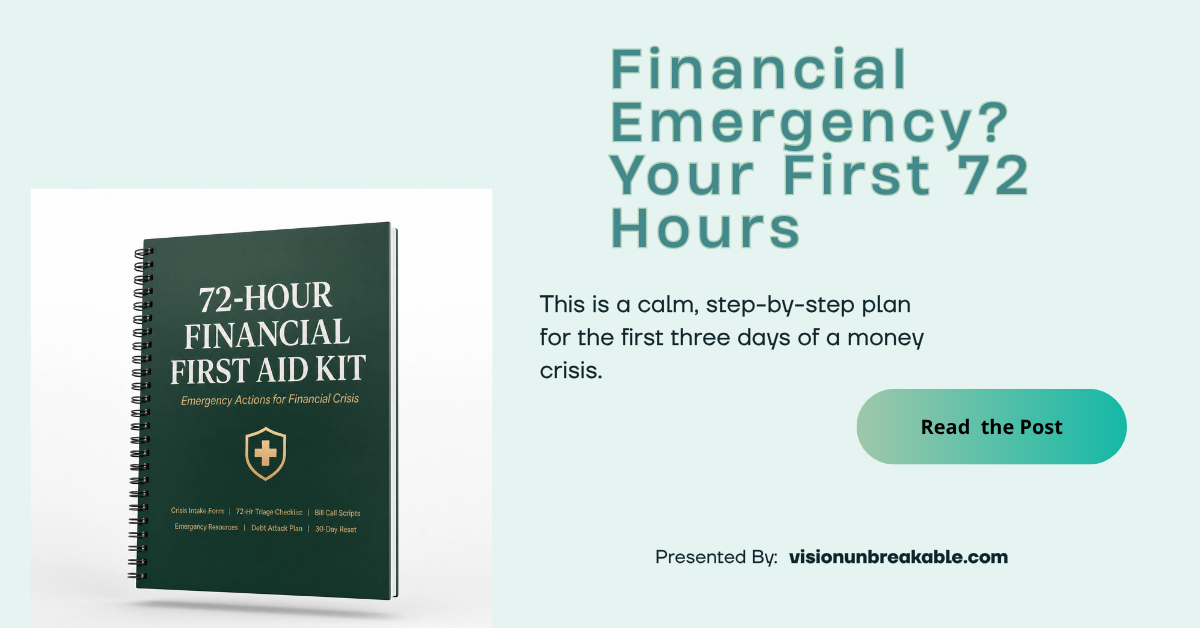
Everything in this article can be done with a notebook. But in the middle of a money crisis, the last thing you need is to build worksheets from scratch — which is exactly why we created the 72-Hour Financial First Aid Kit, a complete financial emergency planner you can download and start using in the next five minutes.
Inside, you'll find:
- Financial Crisis Intake Worksheet
- 72-Hour Financial Triage Checklist
- Financial Command Center
- Bill Priority Matrix
- Debt Attack Planner
- Bill Call Scripts — so you know exactly what to say
- Emergency Resource Directory
- Weekly Spending Trackers
- Financial Recovery Worksheets
- 30-Day Recovery Action Plan
- Accountability Commitment Page
It comes as a printable PDF plus editable Google Docs and Microsoft Word versions, so you can work however feels easiest. It's an instant digital download for $8.99 — less than a single late fee.
Get the 72-Hour Financial First Aid Kit here →
Frequently Asked Questions
What should I do first in a financial emergency?
Before anything else, get your real numbers: current bank balance, cash on hand, bills due in the next 14 days, and income expected in the next 7 days. Every good decision that follows depends on that honest snapshot.
Should I pay my credit cards or my rent first?
Housing comes before unsecured debt — after food and medicine, your rent or mortgage is the top priority, followed by utilities and the transportation you need for work. Make minimum debt payments only after the essentials are covered, and call your card companies about hardship options rather than going silent.
Will creditors really work with me?
Most will — if you call before you miss a payment. Hardship programs, temporary reduced payments, waived late fees, and payment plans are common, but you usually have to ask directly. Politeness, honesty, and calling early go a very long way.
What if I have no income coming in at all?
File for unemployment immediately if you're eligible, then dial 2-1-1 and visit BenefitsCheckUp.org to find every assistance program you qualify for — food, utilities, rent, and more. At the same time, look at quick income options like gig work and selling unused items to bring in cash this week.
How is this different from a regular budget planner?
A financial first aid kit is for the crisis itself — the triage, the calls, the bill priority decisions of the first days and weeks. Once you're stable, a full budget rebuild is the next step, and that's what our Budget Reset Planner is designed for.
You're Already Doing the Right Thing
The fact that you read this far means you're not avoiding the problem — you're facing it. That alone puts you ahead of where panic would have taken you. Work the next 72 hours one step at a time, and if you want every worksheet, script, and checklist ready to go, the 72-Hour Financial First Aid Kit is waiting for you.
This article is for informational and educational purposes only and does not constitute financial or legal advice. Program availability and eligibility requirements vary and are subject to change.
-
Posted in
72 hour financial first aid kit, cant pay bills, emergency budget, emergency financial plan, financial emergency, financial recovery, money crisis